> ## Documentation Index
> Fetch the complete documentation index at: https://www.activepieces.com/docs/llms.txt
> Use this file to discover all available pages before exploring further.
# Overview
> How Activepieces is put together, and why it runs flows the way it does
This section explains **why** Activepieces works the way it does: the components, the execution model, and the trade-offs behind them. If you want to *do* something (size a deployment, set up SSL, scale workers), start with [Configure & Operate](../configure-operate/production-setup). Come here when you want the reasoning under those choices.
This page describes the main components, with a focus on how flows run.
## Components
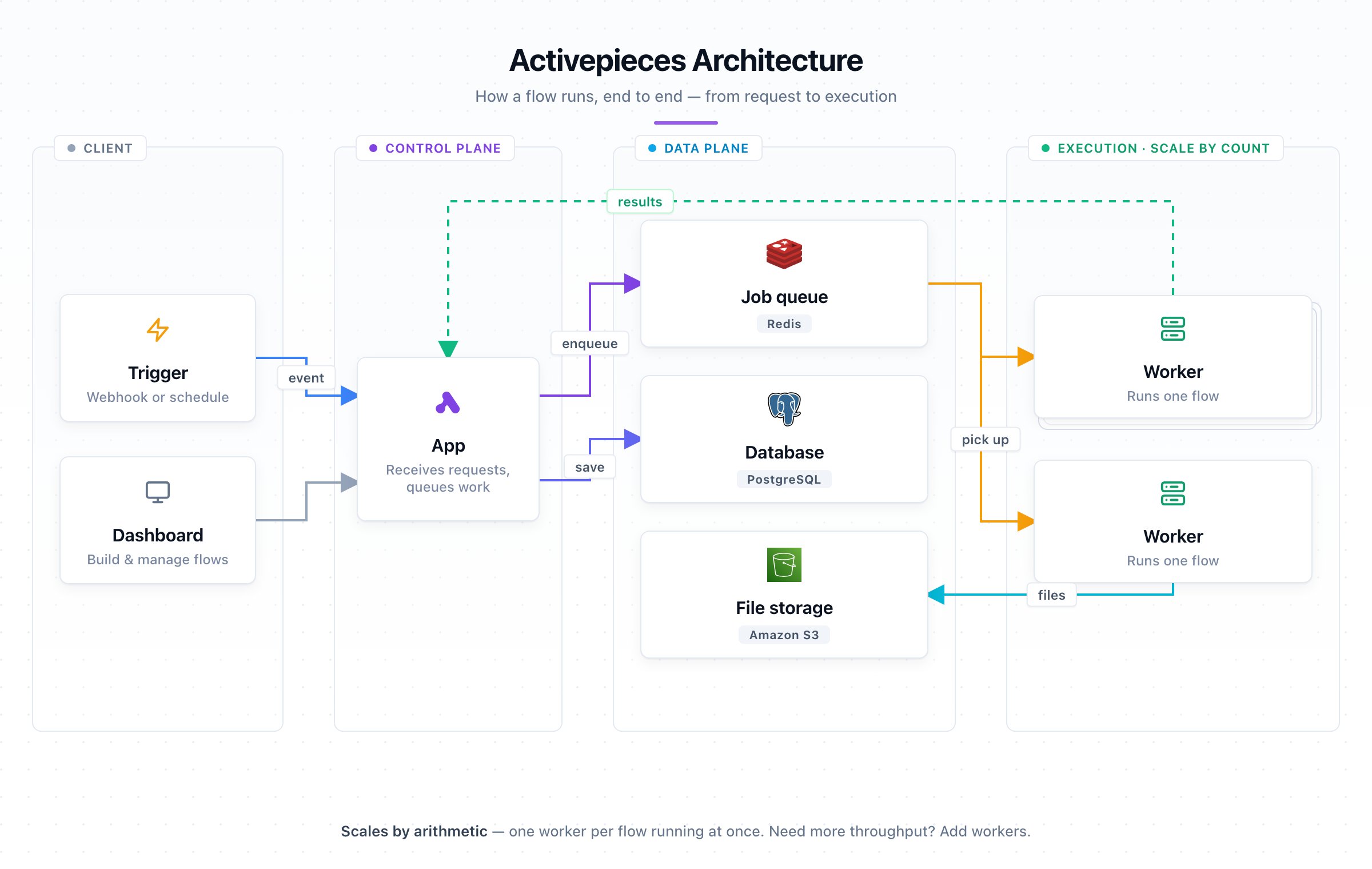 **Activepieces:**
* **App**: The main application that organizes everything from APIs to scheduled jobs.
* **Worker**: Polls for new jobs, allocates a sandbox from the pool, executes the flows with the engine inside the sandbox, and sends results back to the app.
* **Sandbox**: An isolated execution environment that manages process lifecycle, resource limits, and communication with the engine via WebSocket.
* **Engine**: TypeScript code that parses flow JSON and executes it. It is compiled into a single JS file and runs inside the sandbox.
* **UI**: Frontend written in React.
**Third Party**:
* **Postgres**: The main database for Activepieces.
* **Redis**: Powers the queue using [BullMQ](https://docs.bullmq.io/).
## Reliability & Scalability
Postgres and Redis availability is outside the scope of this documentation, as many cloud providers already implement best practices to ensure their availability.
Everything is queue-backed: webhooks and recurring jobs land on Redis, and workers poll them off it. A spike does not drop work. It queues and drains as slots free. For exactly what survives a crash, what runs at-least-once, and where each promise stops, see [Guarantees](../guarantees/crash-recovery).
To scale Activepieces, add replicas of the workers, the app, or the Postgres database. A small Redis instance is enough: it handles thousands of jobs per second and rarely becomes a bottleneck. For the concrete sizing model, see [Production Setup](../configure-operate/production-setup).
## Repository Structure
The repository is a monorepo built with Turbo, with TypeScript as the primary language. It is divided into several packages:
```
.
├── packages
│ ├── web
│ ├── server
│ │ ├── api
│ │ ├── worker
│ │ ├── engine
│ │ ├── sandbox
│ │ └── common
│ ├── ee
│ ├── pieces
│ └── shared
```
* `web`: This package contains the user interface, implemented using the React framework.
* `api`: This package contains the main application written in TypeScript with the Fastify framework.
* `worker`: This package contains the logic of accepting flow jobs and executing them using the engine.
* `server-sandbox`: This package contains the sandbox execution environment, including process isolation, pool management, and WebSocket communication between the worker and engine.
* `common`: This package contains the shared logic between worker and app.
* `engine`: This package contains the logic for flow execution within the sandbox. Located under `server/engine`.
* `pieces`: This package contains the implementation of triggers and actions for third-party apps.
* `shared`: This package contains shared data models and helper functions used by the other packages.
* `ee`: This package contains features that are only available in the paid edition.
**Activepieces:**
* **App**: The main application that organizes everything from APIs to scheduled jobs.
* **Worker**: Polls for new jobs, allocates a sandbox from the pool, executes the flows with the engine inside the sandbox, and sends results back to the app.
* **Sandbox**: An isolated execution environment that manages process lifecycle, resource limits, and communication with the engine via WebSocket.
* **Engine**: TypeScript code that parses flow JSON and executes it. It is compiled into a single JS file and runs inside the sandbox.
* **UI**: Frontend written in React.
**Third Party**:
* **Postgres**: The main database for Activepieces.
* **Redis**: Powers the queue using [BullMQ](https://docs.bullmq.io/).
## Reliability & Scalability
Postgres and Redis availability is outside the scope of this documentation, as many cloud providers already implement best practices to ensure their availability.
Everything is queue-backed: webhooks and recurring jobs land on Redis, and workers poll them off it. A spike does not drop work. It queues and drains as slots free. For exactly what survives a crash, what runs at-least-once, and where each promise stops, see [Guarantees](../guarantees/crash-recovery).
To scale Activepieces, add replicas of the workers, the app, or the Postgres database. A small Redis instance is enough: it handles thousands of jobs per second and rarely becomes a bottleneck. For the concrete sizing model, see [Production Setup](../configure-operate/production-setup).
## Repository Structure
The repository is a monorepo built with Turbo, with TypeScript as the primary language. It is divided into several packages:
```
.
├── packages
│ ├── web
│ ├── server
│ │ ├── api
│ │ ├── worker
│ │ ├── engine
│ │ ├── sandbox
│ │ └── common
│ ├── ee
│ ├── pieces
│ └── shared
```
* `web`: This package contains the user interface, implemented using the React framework.
* `api`: This package contains the main application written in TypeScript with the Fastify framework.
* `worker`: This package contains the logic of accepting flow jobs and executing them using the engine.
* `server-sandbox`: This package contains the sandbox execution environment, including process isolation, pool management, and WebSocket communication between the worker and engine.
* `common`: This package contains the shared logic between worker and app.
* `engine`: This package contains the logic for flow execution within the sandbox. Located under `server/engine`.
* `pieces`: This package contains the implementation of triggers and actions for third-party apps.
* `shared`: This package contains shared data models and helper functions used by the other packages.
* `ee`: This package contains features that are only available in the paid edition.