

Scope: the recommended production shape (
SANDBOX_CODE_ONLY, AP_REUSE_SANDBOX=true, one flow per worker at 0.5 vCPU / 1 GB), measured on GKE with the cluster autoscaler. Other platforms differ mainly in node-provisioning time.How fast capacity arrives
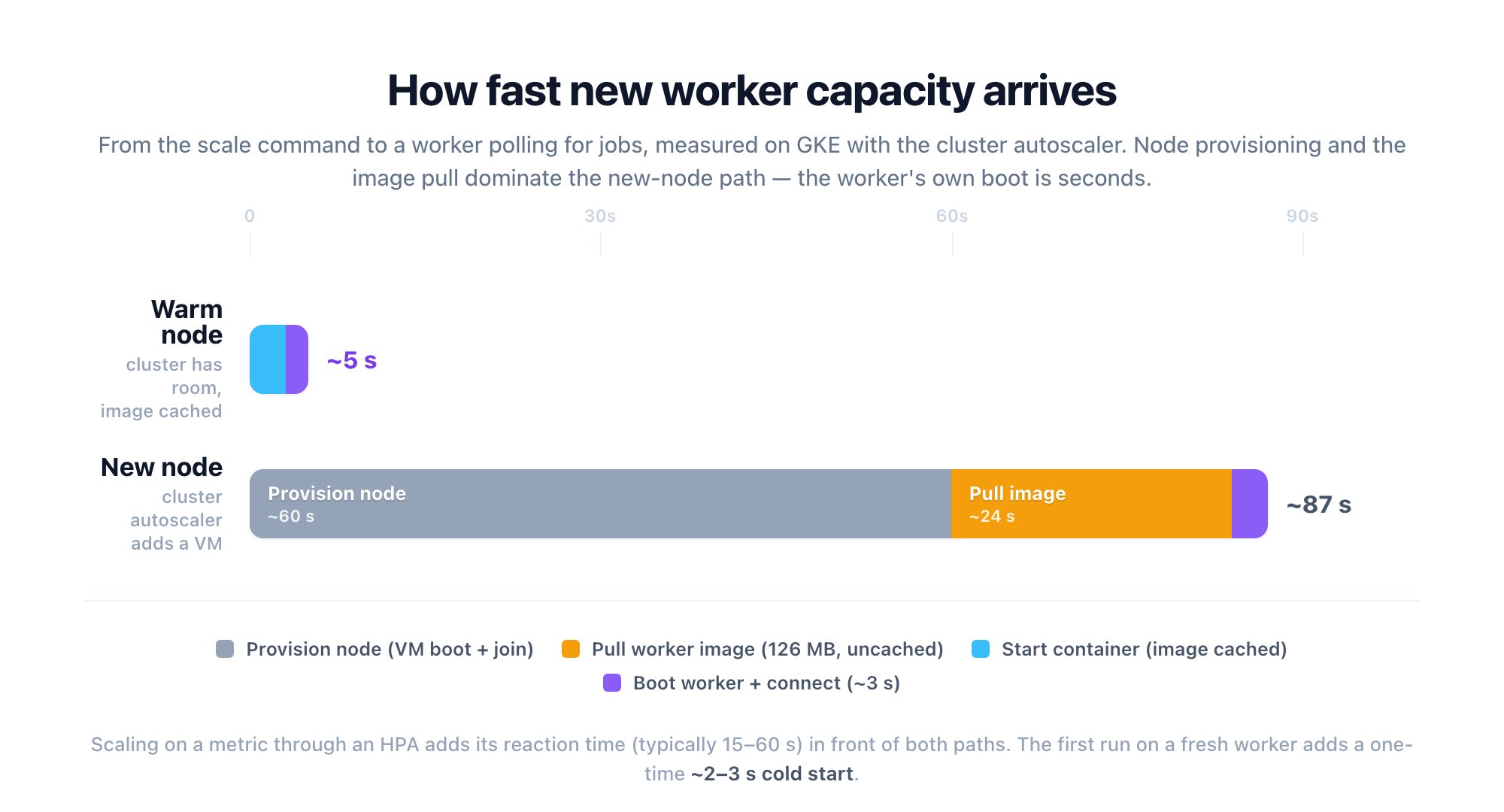
Measured from the scale command to the worker polling for jobs (workers have no readiness probe — pod
Ready only means the container started). The worker’s own boot is ~3–5 s on both paths; node provisioning and the image pull are the difference.
The worker image is 126 MB compressed — a single pre-bundled worker.js with no node_modules — precisely because the pull sits on this critical path (the app image, which you scale rarely, is 551 MB). Keep it in a same-region registry; the pull times above include cross-region transfer.
A new worker’s first flow pays the one-time cold start (~2–3 s, piece install + engine boot); its second run is already warm.
Scaling down is safe
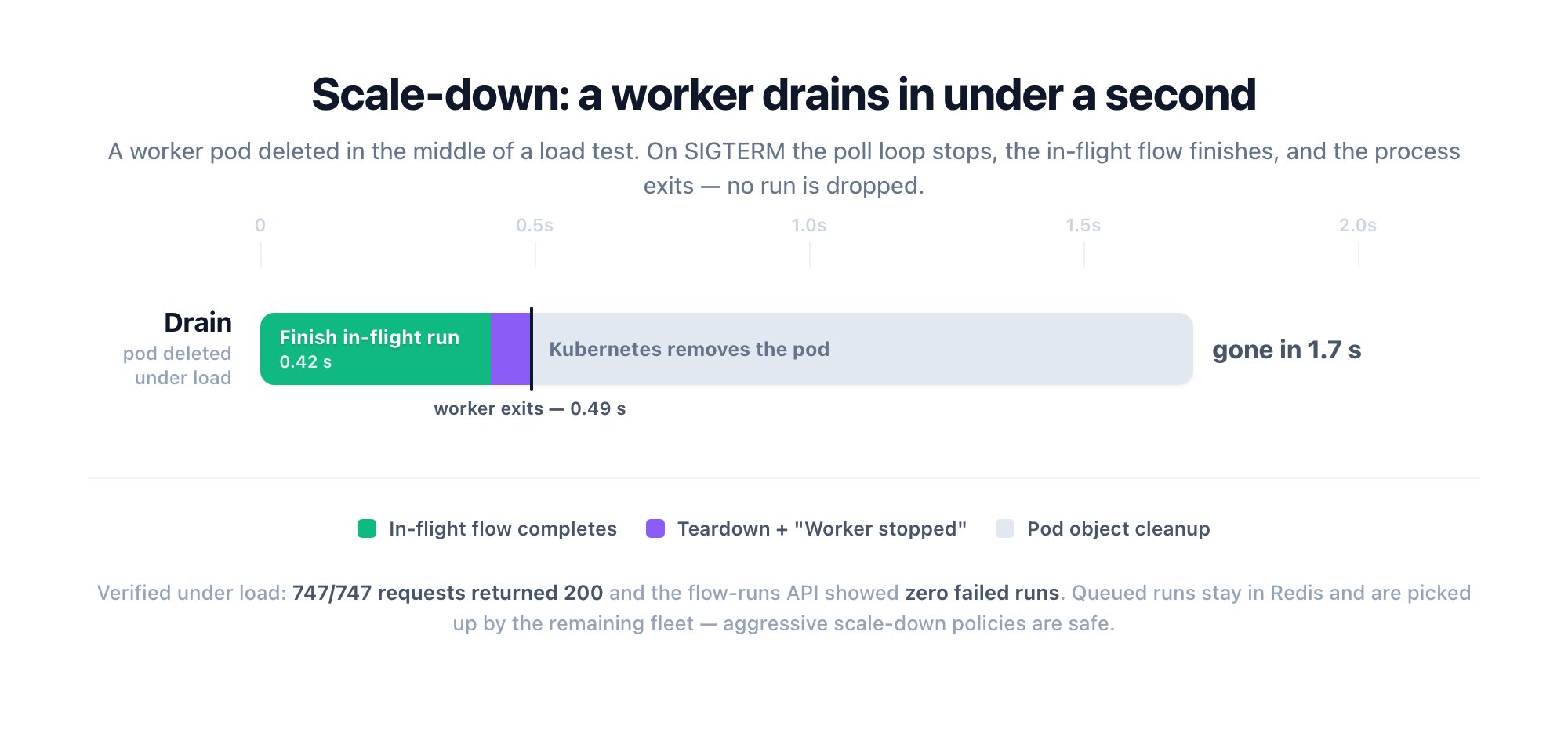
SIGTERM the worker stops polling, finishes its in-flight flow, and exits (forced exit only after 30 s, matching Kubernetes’ default grace period). Deleting a busy pod mid-load lost nothing: every request returned 200 and the flow-runs API showed zero failures. Runs that would have landed on the draining worker stay queued in Redis and drain to the remaining fleet.
When to autoscale — and when not to
- Async and scheduled workloads: autoscale freely. Scale-up lag just shifts the backlog curve; scale on queue depth or worker CPU. Add the HPA’s own reaction time (typically 15–60 s) in front of both paths above.
- Synchronous webhooks: size statically for peak. A burst that needs a new node (~90 s) blows the 30 s sync budget before capacity arrives — hence Production Setup’s pre-sized fleet. Keep min replicas ≥ your sync peak and let the autoscaler own the burst headroom above it.
- Scale-down is free. Drain is sub-second and lossless, so aggressive scale-down policies don’t risk runs.
How this was measured
GKE standard,e2-standard-4 with the cluster autoscaler (2–5 nodes), Activepieces 0.85. Scale-ups timed from kubectl scale to the worker’s “polling for jobs” log line via pod events and worker logs (7 warm samples, 4.6–5.0 s; new-node path timed end-to-end); drain timed from kubectl delete pod under hey load with server-side run statuses verified. Full methodology and raw logs: benchmark/EXPERIMENTS.md (Experiment 2) and benchmark/data/autoscaling-2026-07-02/ in the repo. Throughput and latency for the same shape: Benchmark, Latency.